Europe accounted for approximately 46% of global cycle tourism revenue in 2025, while Asia-Pacific is projected to grow at a 14.8% CAGR through 2035.
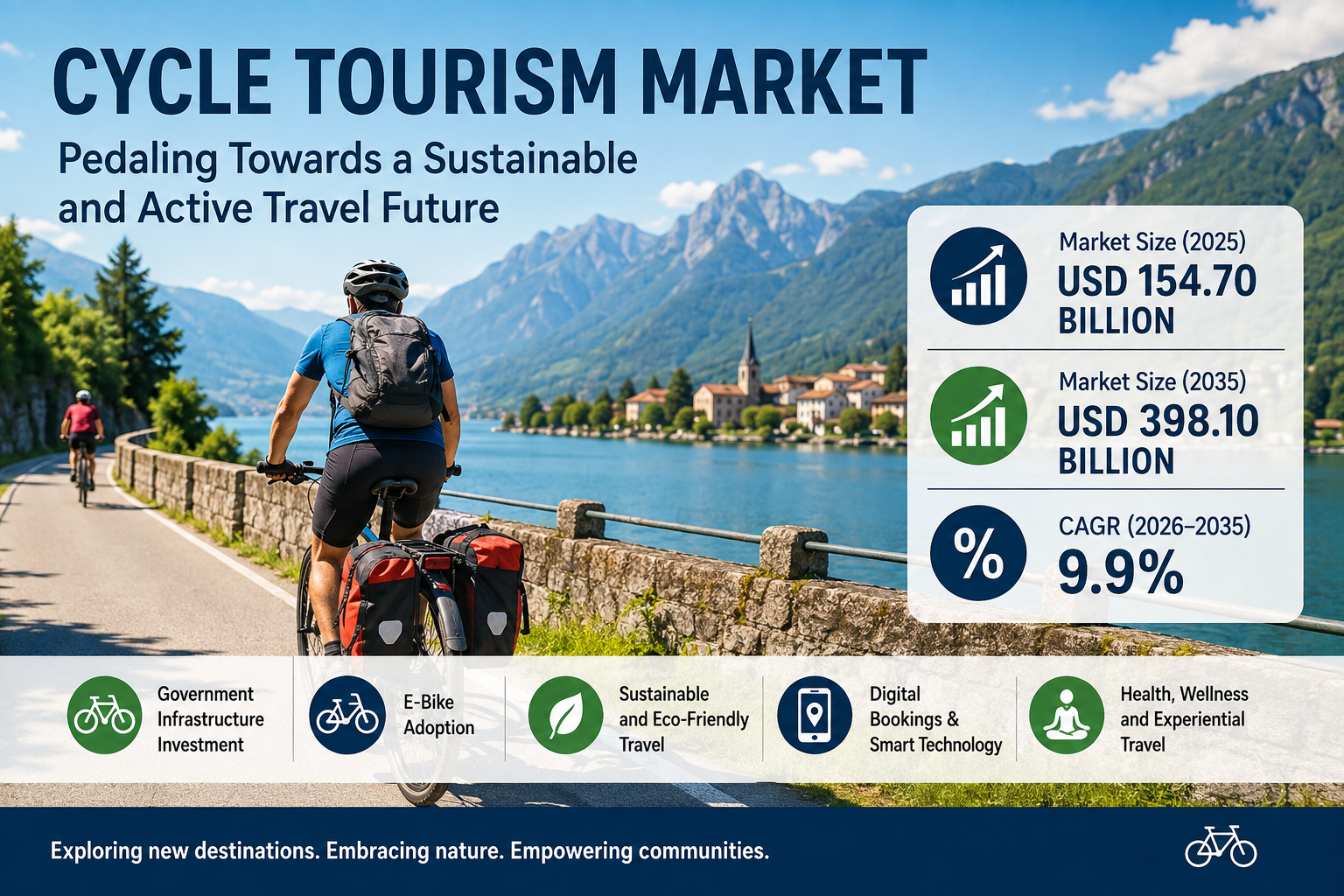
NEW YORK, NY, UNITED STATES, August 26, 2026 /EINPresswire.com/ — The global cycle tourism market is entering a period of accelerated expansion as travelers increasingly combine active lifestyles, outdoor recreation and sustainable mobility with destination-based experiences. According to Market Research Future, the market was valued at USD 154.70 billion in 2025 and is projected to reach USD 398.10 billion by 2035, representing a 9.9% compound annual growth rate (CAGR) from 2026 to 2035.
The projected expansion reflects a fundamental transformation in travel preferences. Cycling holidays are evolving beyond traditional recreational rides into a broad tourism category encompassing guided tours, self-guided journeys, cycling events, culinary routes, wellness retreats, adventure itineraries and increasingly sophisticated e-bike experiences.
Government investment in cycling infrastructure, rising adoption of electric bicycles, growing demand for wellness-oriented travel and the proliferation of digital booking platforms are among the primary forces reshaping the sector. Market research identifies government cycling-infrastructure investment as the strongest market driver, followed by e-bike adoption and fleet expansion, health and wellness travel demand, digital booking proliferation, sustainability initiatives, corporate wellness travel and ancillary comfort services.
Cycle Tourism Moves Into the Mainstream
Cycle tourism has evolved from a specialist niche into an increasingly mainstream component of the global travel economy. Improvements in route infrastructure, accommodation services, digital navigation and bicycle technology are making multi-day cycling holidays accessible to a wider demographic.
The growing availability of electric-assist bicycles has been particularly significant. E-bikes reduce the physical barrier associated with long-distance cycling, enabling travelers with varying fitness levels to participate in touring experiences. According to the market analysis, electric-assist bicycles can extend average daily riding distances from approximately 40 kilometers to 65 kilometers, broadening the potential customer base and allowing operators to develop longer and more diverse itineraries.
The rise of e-bikes is also influencing the premium end of the market. Operators can combine electric bicycles with upgraded accommodations, luggage-transfer services, guided experiences and longer routes to create higher-value packages.
At the same time, cycling tourism is benefiting from a broader consumer shift toward experiential and wellness travel. Travelers are increasingly seeking holidays that combine physical activity, nature, cultural discovery and personal wellbeing rather than conventional sightseeing alone.
Get Full PDF Sample Copy of Report: (Including Full TOC, List of Tables & Figures, Chart) @ https://www.marketresearchfuture.com/sample_request/24546
Government Infrastructure Investment Strengthens Market Foundations
Public investment is playing a central role in creating the infrastructure required for cycle tourism to scale.
The European Union’s Cycling Declaration of 2024 earmarked EUR 2.1 billion for EuroVelo corridor completion, with a target of developing approximately 90,000 kilometers of connected routes by 2030. Such investments can reduce infrastructure uncertainty and encourage private-sector spending on hotels, bike rental, repair facilities, signage, food services and destination experiences along established cycling corridors.
Europe already represents the largest regional market. The region accounted for approximately 46% of global cycle tourism revenue in 2025, supported by mature cycling infrastructure, established tourism ecosystems and cross-border routes. France, Germany and the Netherlands remain important markets, while destinations across Italy, Spain, the United Kingdom and the Nordic countries continue developing cycling-related tourism offerings.
Infrastructure development is also creating opportunities outside traditional European cycling destinations. Governments across Asia-Pacific are increasingly linking active mobility, climate objectives, regional tourism and rural economic development.
Japan’s cycling corridors, South Korea’s Four Rivers Cycle Path network and cycling initiatives in India demonstrate the potential for public infrastructure programs to establish new tourism corridors and distribute visitor spending beyond established urban centers.
Asia-Pacific Emerges as a High-Growth Opportunity
While Europe currently commands the largest share, Asia-Pacific is forecast to be the fastest-growing regional market, with a projected CAGR of approximately 14.8% from 2026 to 2035.
The region’s growth is being supported by expanding cycling infrastructure, rising disposable incomes, increasing interest in experiential tourism and government-backed active-mobility initiatives.
India is positioned as one of the region’s notable growth markets, with market research estimating a 16.2% CAGR for the country’s cycle tourism market. Japan benefits from established destinations such as the Shimanami Kaido, while South Korea’s Four Rivers network provides a major example of large-scale government-supported cycling tourism infrastructure. Thailand, Vietnam, Australia and New Zealand also offer opportunities for adventure and leisure cycling.
As infrastructure improves, Asia-Pacific can potentially capture a larger portion of global cycle tourism spending. The development of safe routes, multilingual wayfinding, bike-friendly accommodation, rental networks and digital booking systems will be particularly important in converting cycling interest into overnight tourism revenue.
E-Bikes Expand the Addressable Traveler Base
E-bike adoption is emerging as one of the most transformative developments in cycle tourism.
Traditional cycling holidays can be perceived as physically demanding, particularly for older travelers, families or tourists unfamiliar with long-distance riding. Electric assistance lowers that barrier while enabling participants to cover greater distances.
The market analysis notes that operators in markets including Austria, Italy and New Zealand have reported higher average booking values when e-bike options are available, with riders more likely to select longer itineraries and premium accommodation.
This dynamic is expanding the market beyond highly experienced cyclists. Travelers aged more than 50 are among the groups benefiting significantly from e-bike accessibility, while younger travelers are increasingly attracted to flexible bikepacking, gravel and self-guided formats.
The result is a more diverse consumer base spanning recreational riders, adventure travelers, couples, families, wellness tourists, corporate groups and performance-oriented cyclists.
Digital Platforms Transform Discovery and Booking
Technology is becoming another critical component of the cycle tourism ecosystem.
Digital route-planning applications, online marketplaces, GPS navigation systems and specialized cycling platforms allow travelers to research destinations, compare itineraries, evaluate accommodation and reserve services with less friction.
Direct booking channels accounted for approximately 60% of the market in 2025, according to the market analysis, but marketplace bookings are projected to expand at a 16.2% CAGR.
The shift toward digital marketplaces is particularly important for small and regional operators. Online platforms can improve visibility, reduce customer-acquisition barriers and provide access to international travelers without requiring operators to build extensive global distribution networks.
At the same time, digital transformation is creating competitive pressure for established operators. As marketplaces aggregate inventory and enable price comparison, operators will increasingly need to differentiate through specialized itineraries, customer loyalty, destination expertise and premium services.
Wellness and Experiential Travel Create Premium Opportunities
The intersection of cycling and wellness tourism is creating another major avenue for market expansion.
Cycling vacations naturally combine physical activity, outdoor environments and destination exploration. Operators are increasingly incorporating yoga, nutrition programs, spa experiences, wellness coaching and healthy cuisine into cycling itineraries.
Such packages can command premium pricing while helping destinations appeal to travelers seeking more purposeful forms of leisure.
Culinary tourism represents another promising opportunity. Cycling routes built around wineries, regional cuisine, farms, artisan producers and cultural attractions can increase visitor spending while distributing tourism revenue across local communities.
Destinations such as Tuscany, Burgundy and the Willamette Valley demonstrate the potential of combining cycling with food and beverage experiences. Similar models can be adapted to emerging destinations in Portugal, Georgia, Argentina and other regions with distinctive culinary identities.
Younger Travelers and Solo Tourism Drive New Demand
Consumer demographics are also changing.
Travelers aged 31–50 accounted for approximately 44% of cycle tourism revenue in 2025, making this the largest age segment. However, the 18–30 age group is projected to grow at a 13.9% CAGR, making younger travelers one of the industry’s fastest-expanding customer cohorts.
Younger consumers are increasingly attracted to self-guided journeys, bikepacking, gravel routes, social-media-friendly destinations and flexible itineraries. Digital navigation and mobile booking tools further reduce the need for traditional guided-tour structures.
Solo cycling tourism is also gaining momentum. Market research estimates that solo travel will grow at approximately 13.1% CAGR through 2035, supported by flexible booking systems, self-navigation technologies and changing preferences among younger travelers.
This trend creates opportunities for operators to develop modular itineraries, flexible accommodation packages and technology-enabled support services designed specifically for independent travelers.
Europe Retains Its Leadership Position
Europe remains the global center of cycle tourism, supported by extensive infrastructure, established cycling cultures and strong connectivity between destinations.
Germany represents a significant European market, while France benefits from major touring destinations such as the Loire Valley and Burgundy. Italy continues to attract travelers through routes across Tuscany and the Dolomites, while Spain is benefiting from growing demand for cycling versions of established pilgrimage and adventure routes. The United Kingdom and Nordic countries also contribute to the region’s established cycling-tourism ecosystem.
The region’s advantage extends beyond physical infrastructure. European cycling destinations often feature established bike-friendly accommodation, repair facilities, luggage-transfer providers, route signage and specialist tour operators.
The EuroVelo network further supports cross-border tourism by connecting destinations across multiple countries, creating opportunities for longer itineraries and multi-destination cycling holidays.
North America Builds on Rail-Trails and Destination Cycling
North America accounted for approximately 24% of global cycle tourism revenue in 2025, making it the second-largest regional market. Growth is supported by rail-trail conversions, state-level tourism programs, cycling events and expanding destination infrastructure.
The United States remains the dominant market in the region, with cycling tourism opportunities spanning Colorado, Oregon, Vermont and other destinations with established trail networks and outdoor recreation ecosystems.
Canada’s extensive trail infrastructure also supports long-distance cycling tourism, while Mexico is emerging as an attractive option for winter-season cycling and coastal touring.
New Opportunities in South America, the Middle East and Africa
Emerging markets are creating additional opportunities as governments and tourism organizations look to diversify visitor experiences.
South America’s cycle tourism market is being supported by eco-tourism, adventure travel and distinctive landscapes. Patagonia, Colombia and Brazil offer opportunities for operators developing routes around nature, culture and outdoor adventure.
In the Middle East, cycling tourism is increasingly connected to broader tourism-diversification strategies. The UAE’s Al Qudra cycling destination and Saudi Arabia’s cycling-corridor ambitions demonstrate growing investment in dedicated cycling infrastructure. South Africa also maintains a strong cycling-event ecosystem, with the Cape Town Cycle Tour contributing significant tourism expenditure.
These markets remain smaller than Europe and North America but offer substantial long-term potential as infrastructure and destination awareness improve.
Fragmentation Creates Room for Specialized Operators
Despite the market’s scale, cycle tourism remains relatively fragmented.
Market research estimates that the five largest operators collectively account for approximately 12% to 16% of market revenue, with a Herfindahl-Hirschman Index below 500. This indicates a market in which regional expertise, local partnerships and specialized experiences remain important competitive advantages.
Leading companies profiled in the market include Intrepid Travel, Backroads, Trek Travel, Butterfield & Robinson, Exodus Travels, DuVine Cycling + Adventure Co., Saddle Skedaddle, G Adventures, TUI Group and Bike Tours Direct. Their strategies span guided tours, premium active travel, adventure cycling, culinary experiences, self-guided itineraries and marketplace aggregation.
The fragmented competitive environment leaves room for new entrants that can combine destination expertise with digital distribution, sustainability credentials and differentiated experiences.
Sustainability Strengthens the Long-Term Outlook
Sustainability is becoming increasingly important across the tourism industry, and cycling is naturally aligned with the transition toward lower-impact travel.
As destinations adopt carbon-accounting frameworks and sustainability-oriented tourism policies, cycling holidays can benefit from their comparatively low dependence on motorized transportation.
Environmental considerations are also influencing travelers’ destination choices and encouraging tourism authorities to invest in active-mobility infrastructure.
For operators, sustainability can become more than a marketing message. Route selection, accommodation partnerships, local sourcing, luggage logistics, equipment lifecycle management and carbon measurement can all contribute to a more credible sustainable-tourism proposition.
Market Challenges Remain
Despite strong growth prospects, the cycle tourism market faces several challenges.
Seasonality remains a significant issue in northern destinations. Operators in Scandinavia and Canada, for example, experience substantial revenue concentration during the warmer months, creating staffing and capacity-utilization challenges.
Safety and liability standards also vary between jurisdictions. Multi-country operators can face higher insurance and compliance costs because cycling regulations, road conditions and liability frameworks differ across markets.
Infrastructure remains another constraint, particularly in emerging destinations where dedicated cycling lanes, safe road surfaces, route signage and roadside services are limited.
Premium cycling holidays can also carry relatively high upfront costs, potentially restricting participation among price-sensitive travelers. Operators addressing this challenge through flexible trip lengths, bike rental options, self-guided packages and tiered accommodation may be better positioned to broaden the market.
Digital Personalization and AI Could Reshape the Next Decade
The next phase of cycle tourism is expected to be increasingly data-driven.
Route-planning platforms already collect information relating to rider preferences, elevation, distance, accommodation ratings and route conditions. This creates opportunities for operators to personalize itineraries based on individual fitness levels, interests and travel behavior.
Artificial intelligence could further automate itinerary planning by combining weather forecasts, trail conditions, rider preferences, accommodation availability and transportation information.
Such systems could enable real-time itinerary adjustments and more efficient packaging of cycling, lodging, food and support services.
Marketplace consolidation is another trend to monitor. Market research projects that marketplace platforms could account for more than 35% of bookings by 2030, compared with approximately 20% in 2025.
For operators, maintaining direct customer relationships through loyalty programs, proprietary booking systems and personalized communications will therefore become increasingly important.
Cycle Tourism Market Outlook Through 2035
The global cycle tourism market is entering the next decade with strong structural momentum. From USD 154.70 billion in 2025, the market is forecast to reach USD 398.10 billion by 2035, growing at a 9.9% CAGR during 2026–2035.
The market’s expansion will be shaped by the convergence of infrastructure investment, e-bike adoption, wellness travel, digital commerce, sustainability initiatives and changing traveler demographics.
Europe is expected to retain its leadership position, but Asia-Pacific is positioned to generate some of the strongest incremental growth. Meanwhile, emerging cycling destinations in South America, the Middle East and Africa can benefit from investment in dedicated routes and destination infrastructure.
Operators that develop differentiated experiences, invest in technology, build strong local partnerships and respond to changing traveler expectations are likely to be best positioned to capture the industry’s expansion.
From culinary cycling holidays and luxury active travel to e-bike touring, solo adventures, corporate wellness retreats and gravel experiences, the sector is increasingly moving beyond the traditional cycling enthusiast.
As governments, tourism authorities, technology companies and travel operators continue investing in the infrastructure and services required to support cycling holidays, cycle tourism is positioned to become an increasingly important segment of the global sustainable and experiential travel economy.
Discover Related Research Reports By Market Research Future:
Rica Tourism Market
https://www.marketresearchfuture.com/reports/rica-tourism-market-67739
Educational Tourism Market
https://www.marketresearchfuture.com/reports/educational-tourism-market-12011
Luxury Cruise Tourism Market
https://www.marketresearchfuture.com/reports/luxury-cruise-tourism-market-25333
Market Research Future
Market Research Future
+1 855-661-4441
email us here
Legal Disclaimer:
EIN Presswire provides this news content “as is” without warranty of any kind. We do not accept any responsibility or liability
for the accuracy, content, images, videos, licenses, completeness, legality, or reliability of the information contained in this
article. If you have any complaints or copyright issues related to this article, kindly contact the author above.

Media gallery