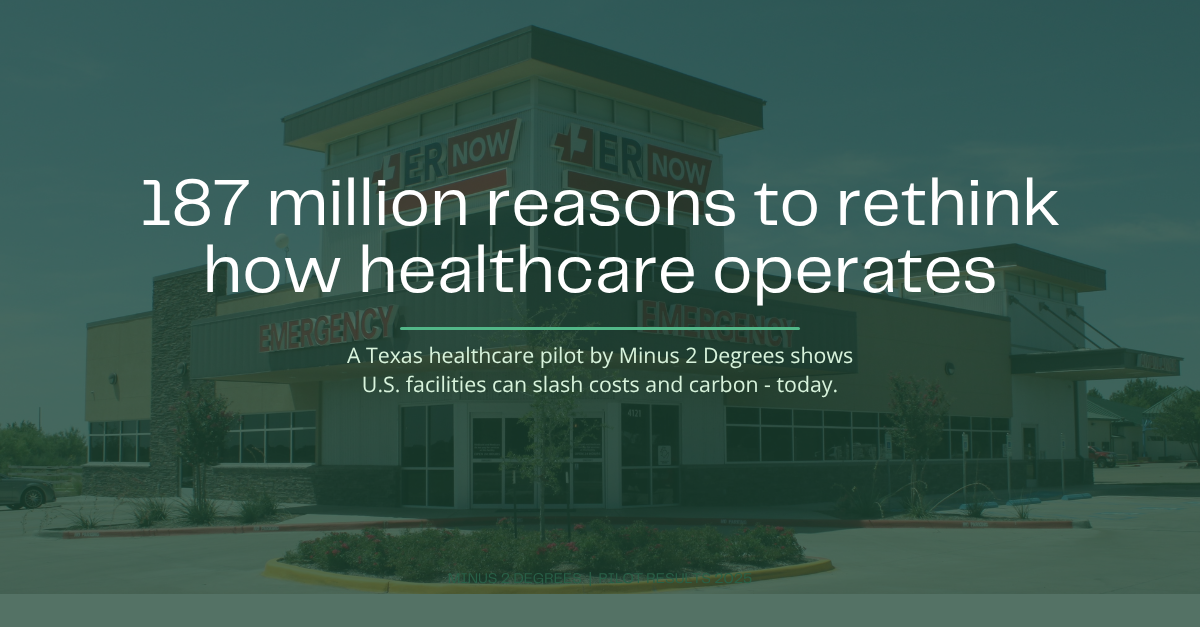
Seven-facility initiative delivers measurable emissions reductions and operational savings through practical, low-disruption changes
DALLAS, TX, UNITED STATES, June 3, 2026 /EINPresswire.com/ — Minus 2 Degrees (M2D), a leading business analytics and carbon reduction partner, has today published results from a pilot program conducted across seven emergency care facilities in Texas aimed at reducing operational waste and lowering carbon emissions.
Across the participating facilities, the program produced over $30,000 in annual cost savings per facility and reduced emissions by more than 900 tons of CO₂e in total. Average emissions fell by approximately 130 tons of CO₂e per facility, with some sites reducing reported emissions by more than 60%.
The landmark pilot program showed that if similar measures were adopted across comparable healthcare facilities nationwide, the U.S. healthcare sector could save more than $187m annually and reduce emissions by approximately 793,000 tons of CO₂e each year.
“We’re delighted with the direct impact of this pilot study. These savings have had a huge and direct impact on how healthcare is managed locally, for the benefit of communities. Healthcare organizations are under increasing pressure to reduce costs, improve operational efficiency, and meet growing sustainability expectations,” said Sadaf Shah, Operations Director at Minus 2 Degrees. “This pilot program shows that practical operational changes can deliver measurable impact, which when rolled out at scale, could be incredible for communities and business across the U.S.”
Texas ($15.4m), California ($10.7m), and Florida ($7.0m) are the states that show the biggest potential savings. According to the Centers for Medicare & Medicaid Services (CMS), U.S. healthcare spending reached $5.3 trillion in 2024, accounting for nearly 18% of GDP, while hospital expenditures totaled more than $1.6 trillion.
Research published in Nature Climate Change has also estimated that the U.S. healthcare sector contributes approximately 8.5% of national greenhouse gas emissions. Making it the world’s fifth-largest carbon emitter. Participating facilities reported substantial emissions reductions between baseline reporting and 2024-2026:
– ER Now (Wichita Falls): 348 to 153 tCO₂e
– Fairfield Emergency Room (Cypress): 148 to 120 tCO₂e
– Emergency Care of Floresville (Floresville): 240 to 112 tCO₂e
– Excel ER (Nacogdoches): 178 to 91 tCO₂e
– Excel ER (Odessa): 276 to 120 tCO₂e
– Schertz Cibolo Emergency Clinic (Schertz): 429 to 126 tCO₂e
– Texas Emergency Care Center (Pearland): 79 to 67 tCO₂e
With more than 6,000 hospitals operating across the United States, alongside thousands of urgent care centers, clinics, and outpatient facilities, the findings point to a significant opportunity for healthcare organizations to improve both operational performance and environmental outcomes through scalable sustainability initiatives.
Healthcare organizations across the U.S. are increasingly exploring sustainability initiatives as energy prices, supply chain pressures, and operational expenses continue to rise. M2D believes the results from the Texas program demonstrate how practical operational changes can help healthcare providers reduce emissions while strengthening long-term business performance.
For finance and operations leaders at participating sites, the program’s impact extended beyond emissions reporting.
“Partnering with Minus 2 Degrees has made sustainability part of how we operate every day,” said Marcos Sanchez, Facility Administrator at Excel ER Odessa. Their insights not only reduced our carbon footprint but also improved our facility’s efficiency and lowered overhead costs. It’s been one of the most impactful partnerships we’ve had.”
“Working with Minus 2 Degrees was very eye-opening,” said Laura Russo, Director of Finance at ProCare Health. “What stood out most was how practical and achievable many of the changes were. We were able to identify operational efficiencies that helped reduce both our carbon footprint and overhead costs. It showed us that sustainability is not just good for the environment, it is also smart business.”
“Minus 2 Degrees gave our company a comprehensive analysis of how we can be proactive in decreasing our daily carbon footprint to help the environment,” said Stephanie Ruiz, Facility Administrator at Schertz Cibolo Emergency Clinic. “We have been able to incorporate their suggested changes to not only create a green infrastructure, but to decrease costs in the process.”
Tom Scott
Trippant
email us here
Legal Disclaimer:
EIN Presswire provides this news content “as is” without warranty of any kind. We do not accept any responsibility or liability
for the accuracy, content, images, videos, licenses, completeness, legality, or reliability of the information contained in this
article. If you have any complaints or copyright issues related to this article, kindly contact the author above.

Media gallery