KIOXIA America, Inc. today announced a breakthrough in high-density storage infrastructure, collaborating with Dell Technologies to deliver a 2U server configuration capable of scaling to an unprecedented1 9.8 petabytes (PB) of flash storage. By combining the Dell PowerEdge™ R7725xd server with AMD EPYC™ processors and 40 KIOXIA LC9 Series E3.L form factor 245.76 terabyte (TB) NVMe™ SSDs, the companies are enabling a new class of storage-optimized platforms built to meet the demands of AI, large-scale data lakes, and data-intensive enterprise workloads.
This press release features multimedia. View the full release here: https://www.businesswire.com/news/home/20260514432882/en/
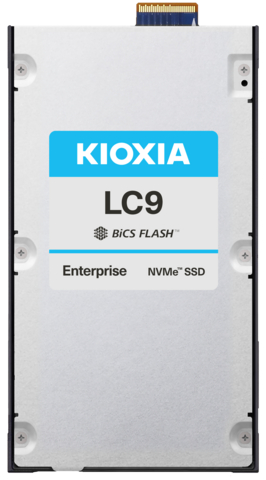
The industry’s first NVMe SSD at this capacity built for the demands of generative AI environments, KIOXIA LC9 Series SSDs deliver up to 245.76 TB of flash-based storage with PCIe 5.0 performance in a range of form factors.
Together, Dell Technologies and Kioxia have a long history of enabling scalable infrastructure for data-driven applications. This latest milestone underscores a shared commitment to advancing high-density architectures that improve performance, reduce energy consumption, and maximize data center efficiency.
“As AI workloads grow more demanding, the infrastructure supporting them must keep pace,” said Arun Narayanan, senior vice president, Compute and Networking, Dell Technologies. “The Dell PowerEdge R7725xd combined with KIOXIA’s high-capacity enterprise SSDs delivers the storage density and power efficiency our customers need to scale AI infrastructure without sacrificing performance.”
Dell PowerEdge R7725xd servers are built for modern AI and data-centric workloads, combining dense storage with powerful compute. These flexible air-cooled storage configurations complement GPU-enabled servers, supporting AI data management and model training by delivering massive storage capacity across the AI lifecycle. These systems support up to 5x 400 Gbps NICs, allowing users to fill and move data through pipelines more efficiently – ultimately making the most of their data. Paired with KIOXIA LC9 Series 245.76 TB SSDs, these systems provide high-capacity, power-efficient solutions that reduce TCO and data center footprint.
KIOXIA LC9 Series SSDs deliver up to 245.76 TB of flash-based storage with PCIe® 5.0 performance in a range of form factors, including 2.5-inch, E3.S, and E3.L2. As the industry’s first3 NVMe SSD at this capacity built for the demands of generative AI environments, the KIOXIA LC9 Series offers a compelling alternative to more commonly used 30.72 TB capacity SSDs. A comparable 9.8 PB configuration would require seven more servers carrying 280 additional drives, resulting in 8x the power consumption4, as well as utilizing more rack space. This results in a more efficient use of space and power, enabling organizations to scale AI infrastructure without expanding their physical footprint or energy consumption.
“Our KIOXIA LC9 Series 245 TB QLC SSD isn’t just higher density, it’s a shift in how we architect AI infrastructures,” noted Neville Ichhaporia, senior vice president and general manager of the SSD business unit at KIOXIA America, Inc. “With the Dell PowerEdge R7725xd server accommodating 40 drives, a whopping 9.8 PB in a single 2U system can be achieved. Customers can deploy massive ingestion streams, scale data lakes effortlessly, and handle large backups in a fraction of the footprint, improving TCO to new levels.”
The solution highlights how tightly integrated compute and storage innovations can unlock new efficiencies for enterprise and hyperscale environments. By delivering extreme density without compromising performance or energy efficiency, Kioxia and Dell Technologies are helping organizations modernize infrastructure to keep pace with accelerating data growth and AI adoption.
For more information, please visit www.kioxia.com, and follow the company on X and LinkedIn®.
About KIOXIA America, Inc.
KIOXIA America, Inc. is the U.S.-based subsidiary of Kioxia Corporation, a leading worldwide supplier of flash memory and solid-state drives (SSDs). From the invention of flash memory to today’s breakthrough BiCS FLASH™ 3D technology, Kioxia continues to pioneer innovative memory, SSD and software solutions that enrich people’s lives and expand society’s horizons. The company’s innovative 3D flash memory technology, BiCS FLASH, is shaping the future of storage in high-density applications, including advanced smartphones, PCs, automotive systems, data centers and generative AI systems. For more information, please visit KIOXIA.com.
© 2026 KIOXIA America, Inc. All rights reserved. Information in this press release, including product pricing and specifications, content of services, and contact information is current and believed to be accurate on the date of the announcement, but is subject to change without prior notice. Technical and application information contained here is subject to the most recent applicable KIOXIA product specifications.
Notes:
1: As of May 14, 2026, based on a KIOXIA survey
2: The 245.76 TB capacity is only available in the E3.L form factor. The 2.5” and E3.S form factors support capacities up to 122.88 TB
3: As of July 21, 2025, based on a KIOXIA survey.
4: As of May 14, 2026, based on a comparison with the 30.72 TB LC9 Series SSD and server power consumption.
Definition of SSD capacity: KIOXIA Corporation defines a kilobyte (KB) as 1,000 bytes, a megabyte (MB) as 1,000,000 bytes, a gigabyte (GB) as 1,000,000,000 bytes, a terabyte (TB) as 1,000,000,000,000 bytes, and a kibibyte (KiB) is 1,024 bytes. A computer operating system, however, reports storage capacity using powers of 2 for the definition of 1GB = 2^30 bytes = 1,073,741,824 bytes and 1TB = 2^40 bytes = 1,099,511,627,776 bytes and therefore shows less storage capacity. Available storage capacity (including examples of various media files) will vary based on file size, formatting, settings, software and operating system, and/or pre-installed software applications, or media content. Actual formatted capacity may vary.
The flash memory capacity is calculated as 1 terabit (1 Tb) = 1,099,511,627,776 (2^40) bits, and 1 terabyte (1 TB) = 1,099,511,627,776 (2^40) bytes.
2.5-inch indicates the form factor of the SSD and not its physical size.
Dell Technologies, PowerEdge, Dell, and other trademarks are trademarks of Dell Inc. or its subsidiaries.
NVMe is a registered or unregistered trademark of NVM Express, Inc. in the United States and other countries.
PCIe is a registered trademark of PCI-SIG.
LinkedIn is a trademark of LinkedIn Corporation and its affiliates in the United States and/or other countries.
Other company names, product names, and service names may be trademarks of third-party companies.
View source version on businesswire.com: https://www.businesswire.com/news/home/20260514432882/en/
Media gallery