The Business Research Company’s Passenger Vehicles Autonomous Driving Global Market Report 2026 – Market Size, Trends, And Forecast 2026-2035
LONDON, UNITED KINGDOM, November 17, 2026 /EINPresswire.com/ — The autonomous driving sector for passenger vehicles is rapidly evolving, driven by advancements in technology and increasing consumer interest in safer, more convenient transportation options. This dynamic market is witnessing impressive growth, fueled by innovation and expanding infrastructure, promising substantial developments in the near future. Let’s explore the current market size, key growth drivers, regional outlook, and defining trends shaping this vibrant industry.
Passenger Vehicles Autonomous Driving Market Size and Growth Outlook
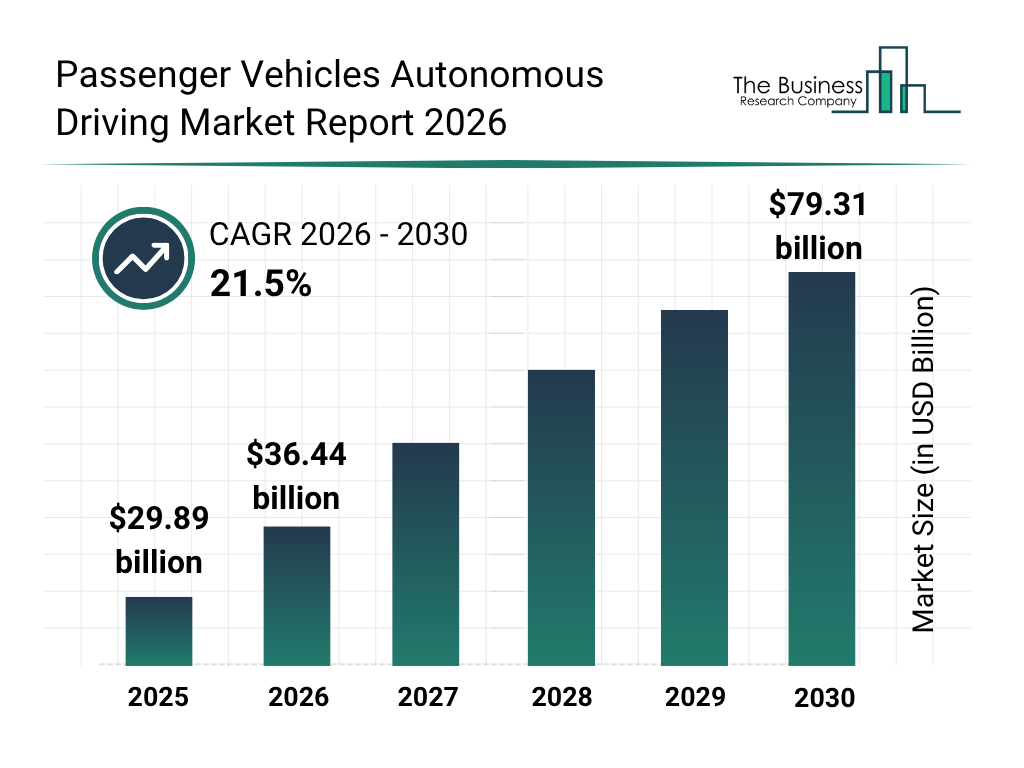
The market for autonomous driving in passenger vehicles has seen remarkable expansion in recent years. It is projected to increase from $29.89 billion in 2025 to $36.44 billion in 2026, reflecting a strong compound annual growth rate (CAGR) of 21.9%. Historically, this surge has been driven by a rising focus on vehicle safety, broader adoption of advanced driver assistance systems (ADAS), heightened consumer demand for convenience behind the wheel, growing investments in autonomous vehicle research, and the development of connected vehicle networks.
Download a free sample of the passenger vehicles autonomous driving market report:
https://www.thebusinessresearchcompany.com/sample_request?id=51218486&type=smp&name=Passenger%20Vehicles%20Autonomous%20Driving%20Market%20Report%202026&utm_source=EINPresswire&utm_medium=Paid&utm_campaign=Nov_PR
Looking ahead, the market is expected to grow even more rapidly, reaching $79.31 billion by 2030 with a CAGR of 21.5%. This future growth will be supported by the increasing deployment of level 3 and level 4 autonomous vehicles, expanding autonomous ride-hailing services, advancements in high-performance automotive computing platforms, stronger regulatory backing for testing autonomous vehicles, and ongoing expansion of vehicle-to-everything (V2X) communication infrastructure. Key trends anticipated to dominate the forecast period include integration of ADAS features, enhanced high-definition mapping and localization, real-time sensor fusion, autonomous emergency maneuvers, and sophisticated vehicle occupant monitoring systems.
Understanding Passenger Vehicle Autonomous Driving Technologies
Passenger vehicle autonomous driving refers to a suite of technologies that enable cars to perform driving tasks with minimal or no human intervention, depending on automation levels. These systems rely on components such as sensors, perception algorithms, precise localization, planning, and control mechanisms. Together, they facilitate crucial functions like obstacle detection, lane keeping, navigation, and decision-making, which collectively improve safety and convenience on the road.
View the full passenger vehicles autonomous driving market report:
https://www.thebusinessresearchcompany.com/report/passenger-vehicles-autonomous-driving-market-report?utm_source=EINPresswire&utm_medium=Paid&utm_campaign=Nov_PR
The Role of Advanced Driver Assistance Systems in Market Growth
One of the most significant factors propelling growth in the passenger vehicle autonomous driving market is the increasing demand for advanced driver assistance systems. ADAS encompass smart vehicle technologies designed to support drivers and enhance safety by automating or assisting various driving tasks. These systems contribute to accident reduction by offering features such as collision avoidance, lane-keeping assistance, and driver alertness monitoring.
The rising adoption of ADAS is a key catalyst for integrating autonomous driving technologies, including sensors, artificial intelligence, computer vision, and vehicle automation. This integration not only boosts road safety but also enhances mobility efficiency. For instance, in October 2025, Thatcham Research, a UK-based automotive research organization, found that 82% of drivers felt safer using ADAS, and 55% reported that ADAS had actively prevented accidents. Features like Autonomous Emergency Braking (AEB) were highlighted as especially beneficial, reinforcing the role of ADAS in driving market expansion.
Regional Market Leadership and Growth Prospects
In 2025, North America held the largest share of the passenger vehicles autonomous driving market, reflecting a mature ecosystem of technology, infrastructure, and regulatory support. Meanwhile, Asia-Pacific is forecasted to experience the fastest growth during the upcoming years, driven by rapidly increasing vehicle demand, government initiatives, and expanding infrastructure in the region. The market report covers a comprehensive range of regions including Asia-Pacific, South East Asia, Western Europe, Eastern Europe, North America, South America, the Middle East, and Africa, providing a global perspective on industry developments.
Our 2026 market reports now feature expanded strategic intelligence through market attractiveness scoring and analysis, total addressable market (TAM) analysis, company scoring matrix graphics and tables, Excel-based dashboards, market hotspots infographics, key technology and future trend analysis, along with updated graphics and tables.
Speak With Our Expert:
Saumya Sahay
Americas +1 310-496-7795
Asia +44 7882 955267 & +91 8897263534
Europe +44 7882 955267
Email: marketing@tbrc.info
The Business Research Company – www.thebusinessresearchcompany.com
Follow Us On:
• LinkedIn: https://in.linkedin.com/company/the-business-research-company“
Oliver Guirdham
The Business Research Company
+44 7882 955267
info@tbrc.info
Visit us on social media:
LinkedIn
Facebook
X
Legal Disclaimer:
EIN Presswire provides this news content “as is” without warranty of any kind. We do not accept any responsibility or liability
for the accuracy, content, images, videos, licenses, completeness, legality, or reliability of the information contained in this
article. If you have any complaints or copyright issues related to this article, kindly contact the author above.

Media gallery